

Algorithms
We develop and apply cutting-edge numerical algorithms, including quantum Monte Carlo methods, Exact diagonalization, and machine learning techniques, to study strongly correlated quantum systems. We also explore quantum optimization and simulation strategies on quantum simulators.
Quantum Monte Carlo
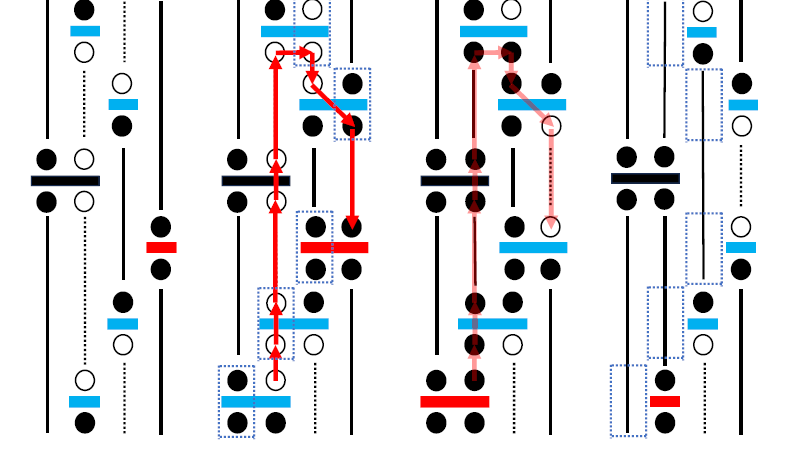 We employ large-scale quantum Monte Carlo (QMC) simulations to study quantum many-body systems. Our work focus on the stochastic series expansion (SSE) methods for studying frustrated magnets, bosonic systems, and quantum phase transitions.
Publications:
- Wei Xu and Xue-Feng Zhang*, "Loop Algorithm for Quantum Transverse Ising Model in a Longitudinal Field", Phys. Rev. B 112, 214441 (2025)
- Dong-Xu Liu, Wei Xu, and Xue-Feng Zhang*, "Analysis of pseudo-random number generators in QMC-SSE method", Chin. Phys. B 33, 037509 (2024)
Other Algorithms
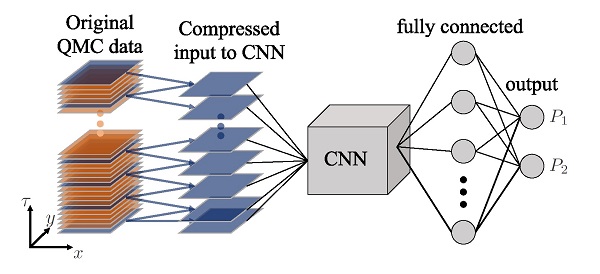 We apply machine learning techniques to quantum many-body physics, using convolutional neural networks (CNN) and other deep learning methods to detect and characterize quantum phase transitions. We also explore quantum optimization algorithms and variational quantum eigensolvers (VQE) for solving complex quantum many-body problems. In addition, some numerical algorithms of quantum many-body computation are employed for quantum metrology.
Publications:
- Yan-Hua Zhou, Xue-Feng Zhang, and Tao Wang*, "Density shift of optical lattice clocks via the multiband sampling exact diagonalization method", Phys. Rev. A 108, 033304 (2023)
- Xiao-Yu Dong, Frank Pollmann, and Xue-Feng Zhang*, "Machine learning of quantum phase transitions", Phys. Rev. B 99, 121104(R) (2019)
- Zheng Yan*, Zheng Zhou, Yan-Hua Zhou*, Yan-Cheng Wang*, Xingze Qiu*, Zi Yang Meng*, and Xue-Feng Zhang*, "Quantum optimization within lattice gauge theory model on a quantum simulator", npj Quantum Information 9, 89 (2023)